
A memory for your architecture your agent can't lose.
RESIN watches your repo locally, seals every architecture decision into a ledger, and feeds it back to your agent automatically.
Your signup position sets your place in line for checkout access. See the tiers in Pricing.
Every agent session starts from a blank context window.
An architecture decision made in one session is invisible to the next, unless it was written to a file the agent actually reads — and even then, loaded instructions are guidance, not enforcement. A CLAUDE.md that states a decision doesn't block a contradictory change the way a test or a hook would. From inside a fresh session, "nobody decided this yet" and "a human deliberately chose this" look identical.
Applied. Nothing flags that a decision two sessions ago moved shared caching to Redis specifically because in-memory caches don't survive a multi-instance deploy. This ships, and quietly diverges per-instance.
Illustrative — the mechanism the interception demo below shows in full.
One command. Runs locally.
npx resin-check finds rule violations, reversed decisions, and dangling references straight from your own git history — nothing leaves your machine. No CLI? Paste your rules file for a much lighter check below.
No network calls from the CLI by default. Zero dependencies. The one opt-in exception shows you the exact payload before anything ever sends.
npx resin-check14// Rust / Tauri, Python. If nothing in that set matches, it says so —15// it does not guess.16// 3. Runs three detectors against the rules file(s) and git history:
83 return (84 filePath.endsWith('.mdc') &&85 rulesIdx > 0 &&86 parts[rulesIdx - 1] === '.cursor'87 );88}8990function findRuleFiles(rootDir) {91 const found = [];9293 function walk(dir, depth) {94 if (depth > MAX_DEPTH) return;
- Zero third-party dependencies — see package.json. Only Node's own
fs,path, andchild_process. - Runs entirely on your machine and makes no network call by default. The one opt-in exception — an emailed remediation guide, offered only after a run that finds something — shows you the exact payload and asks before sending anything.
- Verify it yourself: disconnect your network, then run it. The audit works identically — it never needed a connection.
RESIN itself ships this way: cli/ and core/ are AGPL-3.0-licensed, real source you can read.
This is the lighter check, for people who won't run a CLI. It reads only the text you paste below — it has no git history and can't see anything your agent actually did in a session, so it can't detect rule violations, reversed decisions, or dangling references the way resin-check itself does. All it can honestly tell you is how long your file is.
[ AWAITING_INPUT ]
A real rules file for your agent, built from a short survey — not a generic template.
- — Three baseline rules every kit ships with: respect prior decisions, keep memory files lean, verify before claiming done.
- — A rule block matched to your language or framework.
- — A rule block for solo vs. team, with an explicit-ownership addendum at 6+ people.
- — Dependency-specific rules if we detect Prisma, Zod, tRPC, Zustand, or TanStack Query.
- — Paste an existing rules file and the kit also tells you what it's already covering versus missing.
Observe. Seal. Enforce.
Observe
A local watcher sees every file change and every agent action as it happens — no polling, no upload.
Seal
When an architectural decision is made, it's sealed into a local, immutable SQLite ledger — timestamped, not editable after the fact.
Enforce
Every future agent session gets that decision injected automatically. A proposed change that contradicts it gets flagged before it lands.
Step through it yourself →
Watching src/lib/db/client.ts for the next agent action.
See the receipt before you trust the agent.
Hover or tap a marker to see what it does →
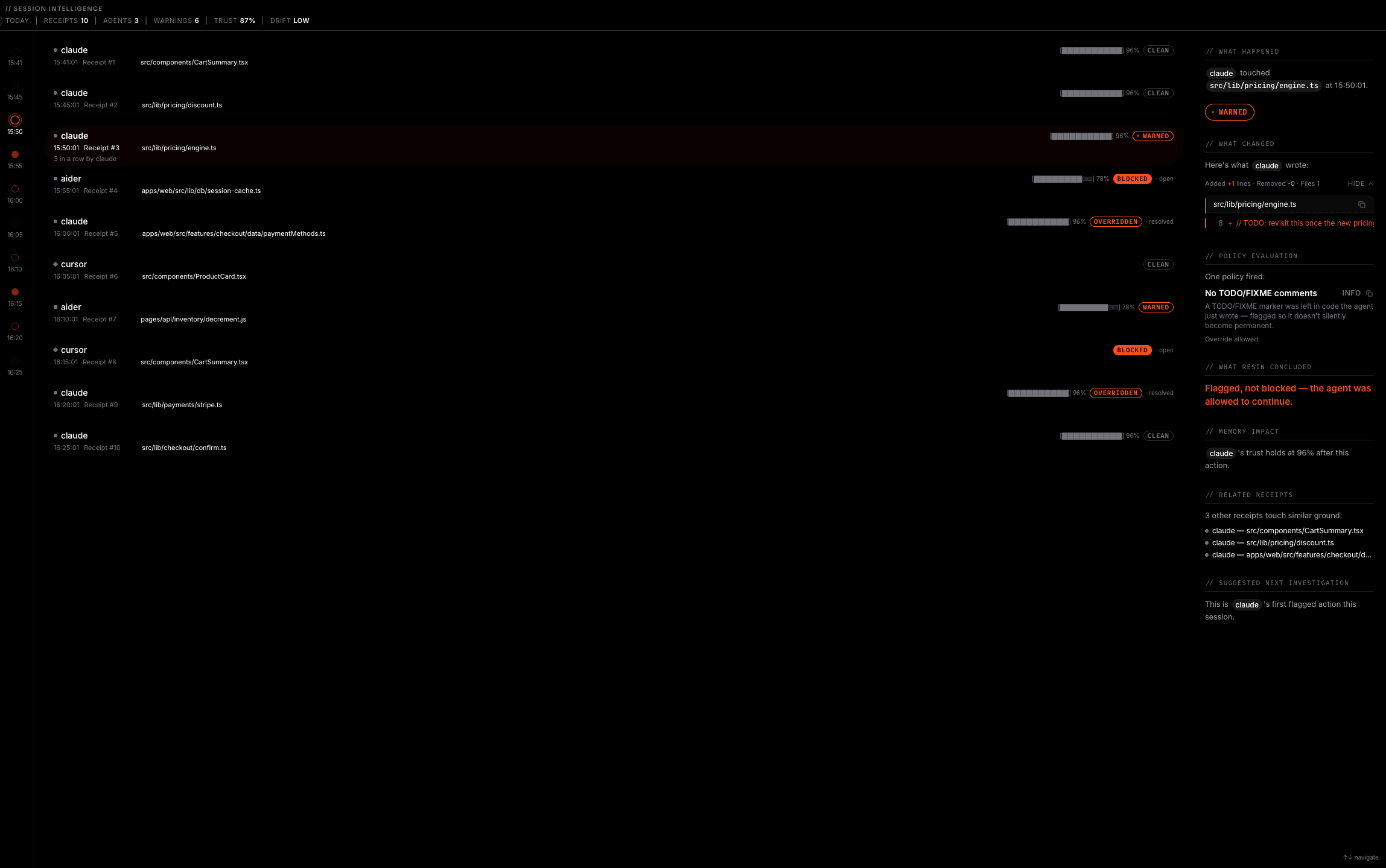
Four markers on the screenshot map to four things RESIN actually tracks — try one.
- Session Trace — a chronological receipt of every agent action, across every tool you use.
- Trust Score — a running confidence read per agent, not just a pass/fail.
- Decision Explorer — search and reopen any past decision, not just the latest one.
- Blueprint — the current architecture graph your rules are actually enforcing.
- Active watchers — the policy checks running against every proposed change, live.
- Shareable receipts — send one flagged decision to a teammate without exporting the whole ledger.
Your code and your decisions never leave the machine.
No telemetry. No account. The check runs against your files, writes its result to a local SQLite ledger, and stops there.
npx resin-checkmemory.db) in your OS's app-data directory — never uploaded.Computed from this browser's own Performance API — open your devtools Network tab and count them yourself if you'd rather not trust this one either.
Own the instrument, or subscribe to what it keeps learning.
Core Free | Solo $99 once | Pro $8/mo or $79/yr | |
|---|---|---|---|
| Projects | Unlimited | Unlimited | Unlimited |
| Active watchers | 2 simultaneous | Unlimited | Unlimited |
| Session Trace | 7-day rolling | Unlimited history | Unlimited |
| Trust Score | Basic | Full history | Advanced intelligence |
| Blueprint | Current graph only | Full (historical replay, cross-project) | Advanced analysis |
| Decision Explorer | Recent decisions only | Full historical search | Intelligent retrieval |
| Rules | 10 custom (unlimited imported) | Unlimited | Intelligence updates |
| Shareable receipts | Yes | Yes | Yes |
| Decision Bundle export | — | Yes | Yes |
| Cross-project memory | — | Yes | Yes |
| Automated ADR generation | — | — | Yes |
| Decision drift detection | — | — | Yes |
| Local security auditing (Ollama-based) | — | — | Yes |
| HaluMem-style hallucination eval | — | — | Yes |
| Skins (Core / Stealth / Dossier / Monolith) | All | All | All |
One payment. Updates included. | New capability lands automatically, release after release. Works standalone or alongside Solo. If you own Solo, cancelling Pro leaves it untouched. |
Team — in active development. No price or feature list yet.
The ladder opens when checkout does. Joining the waitlist now determines your place in the queue — not a purchase, not a locked price.
[ Founder name, photo, and build-log link — not yet public ]
Does RESIN phone home?
No telemetry, no account, no analytics SDK. The CLI check runs entirely on your machine and makes no network call itself — nothing is sent anywhere unless you personally open a link it prints.
Does this website track me?
This page (not the CLI or desktop app, which send nothing) uses cookieless, first-party analytics we run ourselves — no vendor, no cross-site tracking. It records which sections you view and which buttons you click, never your email address or anything you type.
What actually gets stored, and where?
Architecture decisions — the what and the why, not your source code — sealed into a local SQLite ledger on your own disk. Nothing is synced or backed up off-machine by RESIN itself.
Which agents does it work with?
Claude Code, Cursor, and Gemini today — the agents RESIN has a real ingest bridge for, not an aspirational list. Support for another agent means a real bridge shipping first.
Refunds?
TODO_MEASURE — no refund policy is published yet. Ask before you buy if this matters to you now.
What doesn't RESIN do?
It doesn't sync decisions to a shared cloud workspace — Team Sync is priced and planned but not yet built. It doesn't integrate with Slack, Jira, or Notion. And it doesn't generate one giant static context file and call it finished — the point is a queryable ledger, not a bigger CLAUDE.md.
A memory for your architecture your agent can't lose.
Your signup position sets your place in line for checkout access. See the tiers in Pricing.